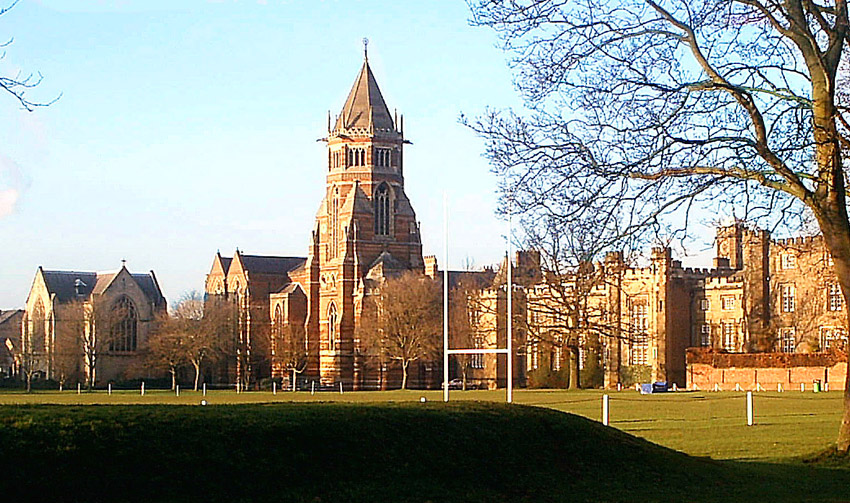
The origin of rugby is reputed to be an incident during a game of English school football at Rugby School, Rugby, England, in 1823 when William Webb-Ellis picked up the ball and ran with it. Although this tale is apocryphal, the Rugby World Cup trophy is named after him. Rugby football stems from a game played at Rugby School, Rugby, which old pupils initially took to university; with Cambridge believing that Old Rugbeian Albert Pell was the first student to form a 'football' team. During this early period different schools used different rules, with former pupils from Rugby and Eton attempting to carry their preferred rules through to their universties.
Significant events in the early development of rugby were the production of the first set of written laws at Rugby School in 1845, the Blackheath Club's decision to leave The Football Association in 1863 and the formation of the Rugby Football Union in 1871. The code was originally known simply as "rugby football"; it was not until after a schism in 1895, which resulted in the separate code of rugby league, that the name "rugby union" came to be used for the game itself. Supporters of both codes will frequently refer to theirs as merely "rugby", unless they are differentiating between the two.
The first rugby international took place on 27 March 1871, played between England and Scotland. By 1881 both Ireland and Wales had representative teams, and in 1883 the first international competition, the Home Nations Championship had begun. 1883 also saw the first rugby sevens tournament at Melrose - the Melrose Sevens, which is still held annually. Five years later two important overseas tours took place; a British Isles team visited Australia and New Zealand - although a private venture, it laid the foundations for future British and Irish Lions tours; and the 1888 New Zealand Native team brought the first overseas team to British spectators.
From 1905 through to 1907, all three major Southern Hemisphere rugby countries sent their first touring teams to the Northern Hemisphere; Dave Gallaher's New Zealand in 1905, followed by Paul Roos' South Africa in 1906 and then Herbert Moran's Australia. All three teams brought new styles of play, fitness levels and tactics, and were far more successful than critics at first believed. 1905 also saw the first French internationals.
The years during both World Wars saw an end of international rugby games and union-sponsored club matches, but competitions continued with service teams such as the New Zealand Army team.
In 1973 the first officially sanctioned international sevens tournament took place at Murrayfield, as part of the Scottish Rugby Union centenary celebrations. In 1987 the first Rugby World Cup was held in New Zealand and Australia, and the inaugural winners were New Zealand. The first World Cup Sevens tournament was held at Murrayfield in 1993.
Rugby union was famously an amateur sport until the IRB declared the game 'open' in 1995, removing restrictions on payments to players. However, the pre-1995 period of rugby union was marked by frequent accusations of "shamateurism" in some quarters.
Get Rugby Union Tickets from Sold Out Ticket Market at low cost.

Subscribe to:
Post Comments (Atom)

No comments:
Post a Comment